
Custom Tote Bags in Bulk: Options, Pricing and Ordering Guide
Everything a B2B buyer can customise on a tote bag - fabric, size, handles, print, lining, hardware - with realistic bulk pricing tiers, MOQ rules, sampling steps and the spec sheet that gets accurate quotes first time.
7 min readcustom tote bagswholesaleB2B
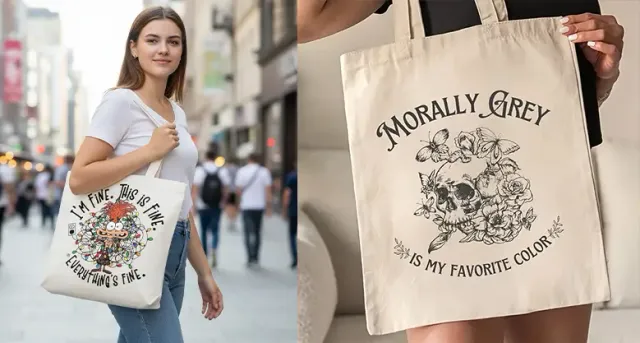
"Custom tote bags" covers everything from a $1 giveaway to a $9 lined retail piece, and the gap between those bags is a stack of specification decisions most buyers never see written down. This guide walks through every option you can actually customise - fabric, size, handles, print, lining, hardware - what each one does to the unit price, and the ordering mechanics (MOQ, sampling, timeline) that decide whether your first production run lands on spec and on date.
What you can customise on a tote bag
A tote has six customisation zones, and each is an independent price lever. Fabric is the biggest: light 5-6 oz cotton for giveaways, 8-10 oz canvas for daily-use retail totes, 12 oz+ or laminated fabrics for structured premium pieces - the full decision logic is in our tote bag fabric guide. Size and gusset come next: a wider base gusset turns a flat envelope into a grocery-capable carrier for $0.20-0.40 of extra cloth. Handles decide how the bag feels in use - self-fabric handles are cheapest, cotton webbing adds $0.15-0.35 and survives years of load, and long-plus-short double handle sets add $0.50-0.90 but let one bag work on shoulders and in hands. Closures range from open-top (free) through magnetic snap ($0.20-0.40) to full zip top ($0.60-1.10). Lining and interior pockets add $0.70-1.50 and move the bag from promo into retail territory. Hardware - rivets, branded zip pulls, metal feet - runs $0.10-0.60 per piece and does disproportionate work on perceived quality, the same logic that applies across bag coatings and trims.
Print methods and where each one wins
Decoration is where custom tote projects most often disappoint, and almost every failure traces to a mismatch between artwork and method. Screen printing is the bulk workhorse: $0.15-0.40 per colour per position, excellent opacity on natural canvas, and the most durable hand after repeated washing - but each colour is a separate screen, so 4+ colour artwork gets expensive fast. Heat transfer and DTF (direct-to-film) reproduce photographic and gradient artwork with no per-colour penalty, making them the right call for complex logos at 300-1,000 piece quantities; their trade-off is a slightly plasticised surface feel on heavy canvas. Embroidery reads most premium for compact marks under 10 cm and effectively never wears out, at $0.50-1.20 per position. Two spec-sheet rules prevent most reprints: state print position and maximum dimensions in centimetres (not "centered, big"), and supply vector artwork with Pantone references rather than screenshots - mill-side colour matching against a Pantone code is the difference between a brand colour and "close enough".
Bulk pricing: what moves the number
Tote pricing is a bill of materials, and seeing the stack makes quotes negotiable line by line instead of as a blanket discount. For an 8-10 oz canvas tote with webbing handles and a 2-colour print at 1,000 pieces: fabric $1.10-1.80 (consumption maths in how much fabric a bag needs), cutting and sewing $0.70-1.20, handles and trims $0.25-0.60, printing $0.30-0.80, packing $0.10-0.20 - landing ex-factory around $2.45-4.60. Quantity breaks matter most between 300 and 3,000 pieces, where setup costs (screens, cutting markers, sampling) amortise; beyond 5,000 pieces the curve flattens to fabric economics. The honest cost-reduction levers, in order of impact: drop to a lighter fabric only if the use case allows, cut print colours from three to two, switch zip top to open top, and consolidate colourways. What not to cut: handle attachment stitching (bar tacks or X-box stitches) and seam margins - the two failure points that turn a cheap tote into a returned order, as covered in our pre-production fabric tests.
MOQ, sampling and the order timeline
Custom tote MOQs are friendlier than most buyers expect, with one structural rule: stock inputs keep minimums low, custom inputs raise them. Stock-fabric totes with screen printing start at 100-300 pieces. Custom-dyed fabric triggers a dye-lot minimum - usually 500-1,000 metres - so custom colours belong in programmes, not pilots; the mechanics are in our MOQ and lab dips guide. Mixed runs split a single MOQ when variants share fabric and construction: two sizes or three stock colours typically need only 100-200 pieces per variant. The timeline that holds in practice: 5-10 days for a pre-production sample, 3-7 for one revision round, 20-35 days bulk production, then freight - 25-35 days by sea to most Western markets, 5-8 by air at two to three times the cost on bulky goods. Write two safeguards into the PO: the approved sample held as the quality reference, and an AQL inspection stage before balance payment.
Five ordering mistakes that cost real money
The same five mistakes account for most failed tote projects. First, approving artwork on screen instead of on cloth - colours shift on natural canvas, so always approve a printed strike-off. Second, skipping the gusset measurement: two totes with identical face dimensions carry completely different loads, and "like the sample but bigger" is not a spec. Third, letting the factory choose handle attachment - glued or single-stitched handles are the top field failure on promo totes, so specify bar tacks or X-box stitching explicitly. Fourth, ordering the full quantity without a pre-production sample to save a week; a reprint costs six. Fifth, quoting only one factory, which removes every benchmark for price and spec - three comparable quotes on the same six-line spec is the minimum for a first order. None of these safeguards adds more than days or cents; all of them are cheaper than their failure mode by an order of magnitude.
The six-line spec that gets accurate quotes
Factories quote fast and accurately when the enquiry removes guesswork. Six lines do it: quantity and colourway split; fabric type and weight (or "match attached sample"); finished dimensions with gusset; handle type and drop length; print method, artwork file and Pantone references; and the in-hands date with destination port. Send those six lines to three factories and the quotes come back comparable - same inputs, same assumptions - which is the entire point. Send "price for 500 custom totes?" and every number you get back is a placeholder built on the cheapest assumption at every zone.
If you want fabric and bag under one roof - mill-direct cloth, cutting, sewing and inspection without a trading layer - the group's factory side runs custom tote programmes on its own custom fabrics with in-house quality assurance, and offers a free sample service to put real cloth in your hands before you commit. Send your six-line spec through the contact form and we will return a quote with the fabric spec sheet attached.
Free colour card and swatches
Get the colour card and three fabric proposals for your bag
Tell us the bag type and target price. We reply with two or three fabric options, swatches by courier and, if you need the bags made, a sample plan from our sister factory.