
Six Fabric Tests Before a Roll Is Cut - and Why Each One Exists
GSM, D65 colour, crockmeter, coating adhesion, hydrostatic head, Martindale. What each test catches, what it costs when skipped, and the pass marks we use on every roll for bag manufacturing.
6 min readquality controltestinginspection
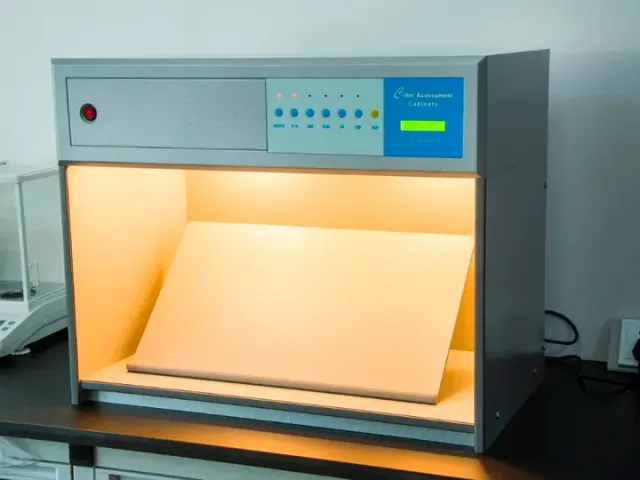
Every test on our inspection frame exists because we once skipped it and paid for the container. This is the list, in the order a roll meets it, with the failure each one prevents.
1. Weight (GSM)
Tool: circular GSM cutter and balance. Pass: within +/- 5% of spec. Catches: mills substituting lighter yarn or fewer picks. "600D" from two mills can differ by 40 gsm; the lighter one wears through at the base corners first.
2. Colour in a D65 cabinet
Tool: light cabinet at D65 (daylight), also checked under TL84 (store) and A (incandescent). Pass: within shade band A/B of the sealed lab dip. Catches: shade drift between dye lots, and metamerism - two fabrics that match under shop lights and clash outdoors. Every roll, not a sample per lot, because dye lots split.
3. Rubbing fastness (crockmeter)
Tool: crockmeter, dry and wet. Pass: grade 4+ dry, 3-4+ wet (ISO 105-X12). Catches: dye that transfers to clothing. Dark linings and PU leather trims are the usual offenders; indigo denim is tested with fixing.
4. Coating adhesion and defects
Tool: inspection frame at 100 m per roll, tape peel on coating. Pass: coating does not lift; defects logged per 100 m under the 4-point system, max 20 points. Catches: PU or PVC that peels after a season, plus weaving faults, oil marks and holes that would otherwise be cut into panels.
5. Hydrostatic head
Tool: hydrostatic head tester. Pass: as specified - 1,000 mm standard PU, 2,000 mm outdoor, > 5,000 mm TPU. Catches: coatings applied too thin. Run on pre-production samples and on every TPU lot.
6. Abrasion, tensile and tear
Tool: Martindale abrasion tester; tensile/tear tester. Pass: Martindale 15,000+ for 600D polyester, 50,000+ for 1000D nylon; tensile and tear to spec. Catches: base fabrics that will not survive the bag's life. Run on pre-production samples and any new mill.
What we add by market
- GCC / hot climates: light-fastness (ISO 105-B02) grade 5+, perspiration fastness, 50 C conditioning.
- EU retail: REACH screening, phthalate test on PVC, cold-flex at -10 C.
- US: CPSIA lead and phthalate, Prop 65.
- Recycled: GRS transaction certificate reconciled to roll numbers.
After the fabric
Fabric tests stop fabric problems. Seam, zipper, handle and load failures are caught on the finished bag - the six-gate, fourteen-test bag QC process at our sister factory covers those, from cutting-room checks to a 100% final inspection before packing.
Every roll we ship carries its test record. Ask for it with your first order; you should never have to take a fabric supplier's word for a number that a machine can print.
Free colour card and swatches
Get the colour card and three fabric proposals for your bag
Tell us the bag type and target price. We reply with two or three fabric options, swatches by courier and, if you need the bags made, a sample plan from our sister factory.