
How to Read a Bag Fabric Spec Sheet: Denier, GSM, Coating Codes and Test Lines Explained
A supplier sends you '600D PU 0.5mm W/R 58in 320gsm' and expects a decision. This guide decodes every line of a bag fabric spec sheet - construction, weight, coating stack, width, colour standard and test clauses - with the red flags we check before any roll is approved.
7 min readspec sheetdenierGSMsourcing
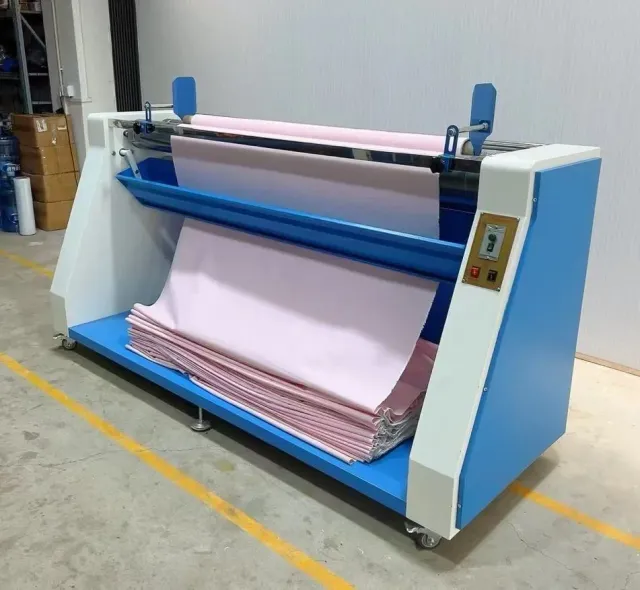
A one-line quote like 600D PU 0.5mm W/R 58" 320gsm carries six separate engineering decisions. Buyers who can read it catch problems at the quotation stage, before any money moves. Buyers who cannot end up discovering them at the container door. This is the line-by-line decode we give every new customer of our fabric library.
Line 1: construction - what "600D" actually promises
Denier is the weight in grams of 9,000 metres of the yarn. It describes the yarn, not the fabric. Two mills can weave "600D" with different thread counts and hand you fabrics that differ by 15% in weight and tear strength.
That is why a complete spec line reads 600D x 600D / 64T: warp yarn, weft yarn, thread count. If the T-count is missing, ask. A 600D at 58T quoted 3% cheaper is not the same fabric as a 600D at 64T - it is a lighter, weaker cloth wearing the same name. Our 600D vs 900D vs 1680D guide covers when each construction earns its cost.
Line 2: weight - GSM is the truth serum
Grams per square metre is the single hardest number to fake. Yarn denier, coating thickness and thread count all show up in it. We weigh a 100 cm2 die-cut disc from every roll; the pass window is ±5% against the sealed standard.
Quick sanity checks for coated polyester:
| Construction | Expected GSM (PU coated) |
|---|---|
| 300D | 170-210 |
| 600D | 260-330 |
| 900D | 330-390 |
| 1680D | 430-520 |
A "600D" quoted at 230 gsm is either uncoated, loosely woven, or not 600D.
Line 3: the coating stack
PU 0.5mm W/R decodes as: polyurethane coating, 0.5 mm total thickness, water-repellent finish on the face. The three failure points hide here:
- PU vs PVC vs TPU changes cold-crack behaviour, EU compliance and weldability - the full trade-offs are in our coating guide.
- Thickness quoted in mm should come with a tolerance. We accept ±0.05 mm.
- W/R is a finish, not a membrane. It makes water bead; it does not make a bag waterproof. If the brief says waterproof, the spec needs a hydrostatic-head number (mm H2O), not a W/R note.
Line 4: width - the quiet margin killer
58" (147 cm) is cuttable width, not loom width. A 2" difference between quoted and usable width changes your cutting yield by 3-4% on a typical backpack marker - silently, on every metre you buy. Confirm whether the number includes selvedge, and have the cutting room measure the first roll of every colour.
Line 5: colour standard
"Black" is not a colour standard. A real spec line names the system and the light source: Pantone 19-4007 TPX, dE <=1.0 under D65. Two rolls can match under a warehouse's fluorescent tubes and split visibly in daylight - that is metamerism, and it is why every approval we issue is checked in a D65 cabinet against a sealed lab dip. The full dyeing workflow is in how custom colour actually works.
Line 6: the test clauses - where good sheets differ from paper
Anyone can print the five lines above. The difference between a spec sheet and a promise is the test table at the bottom. The six we run on every roll are detailed in six fabric tests before cutting; as a minimum for bags, the sheet should commit to:
| Property | Method | Typical bag-grade pass |
|---|---|---|
| Tear strength | ASTM D2261 | >=35 N (600D) |
| Abrasion | Martindale / ASTM D4966 | >=20,000 cycles |
| Colour fastness to rubbing | ISO 105-X12 | >=4 dry / >=3 wet |
| Coating adhesion | tape pull | no lift |
| Hydrostatic head (if waterproof) | ISO 811 | per end use, stated in mm |
If a supplier will not put methods and pass marks in writing, the numbers do not exist.
The five-minute red-flag scan
- No T-count next to the denier.
- GSM missing or outside the sanity table above.
- "Waterproof" with no hydrostatic-head figure.
- Width without selvedge clarification.
- Colour named in words instead of a Pantone/CSI code with a light source.
Any one of these costs more to fix after bulk than the fabric itself.
Get a spec sheet you can hold us to
Every quotation we issue ships as a full spec sheet in this exact format, with the test table filled in - and the sealed swatch to match. Compare it against your current supplier's one-liner: request a free colour card and swatches, or see how the same specification carries through to a finished bag at our sister factory's fabric guide.
Buyer FAQ
What should a complete fabric spec line include?
Construction with thread count (600D x 600D / 64T), GSM with tolerance, coating type and thickness, finish, cuttable width, colour standard with light source, and a test table with methods and pass marks.
What is the difference between denier and GSM?
Denier describes the yarn (grams per 9,000 m); GSM weighs the finished cloth per square metre. Two 600D fabrics can differ 15% in GSM through thread count and coating - GSM is the number that cannot hide.
Free colour card and swatches
Get the colour card and three fabric proposals for your bag
Tell us the bag type and target price. We reply with two or three fabric options, swatches by courier and, if you need the bags made, a sample plan from our sister factory.