
Fabric Specs for Tactical Backpacks: 1000D Nylon, Laminates and IR Compliance
Tactical bags are specified harder than any other category. What 1000D nylon, 500D laminates, solution dyeing and IR-safe colour actually mean on a spec sheet, and how to test for them.
6 min readnylontacticalbackpacks
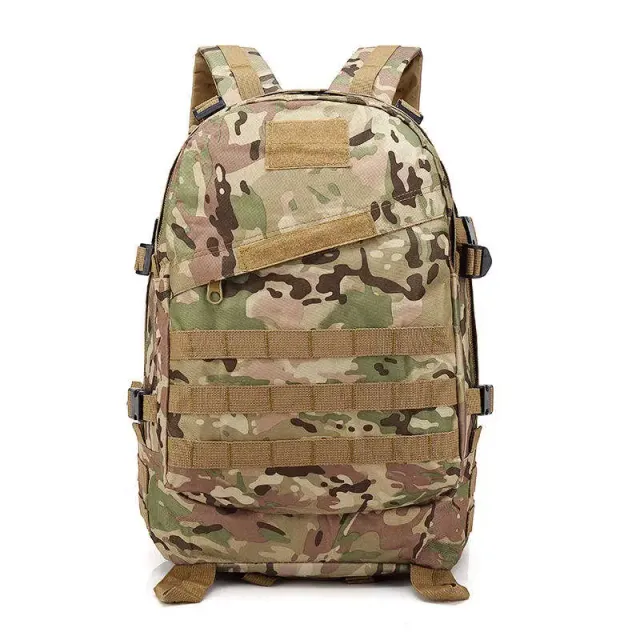
Tactical and duty bags are bought by people who read spec sheets and return product that misses them. The fabric section of that spec sheet has four lines that matter.
1. Body fabric: 1000D nylon with PU coating
1000D nylon - Cordura-type nylon 6.6 at 380-420 gsm - is the tactical body fabric. It runs 50,000+ Martindale cycles where 600D polyester manages 15,000-20,000, and it does so at roughly the weight of 900D polyester. PU coating at 1,000-2,000 mm handles rain; DWR on the face sheds it.
Genuine Invista Cordura is available on request at higher MOQ. Our stock 1000D is a Cordura-type from audited mills with comparable abrasion figures, and we quote both.
2. MOLLE panels: 500D laminate for laser-cut PALS
Modern tactical designs replace sewn MOLLE webbing with laser-cut slots in a laminated panel. That panel is usually 500D nylon bonded to a second layer - another 500D, a TPU film or a Hypalon-type sheet - so the cut edge does not fray and the slot holds a strap under load.
We stock 500D nylon and laminate to order. Cut edges are checked for seal and slot pull-strength on the pre-production sample.
3. Colour: solution-dyed nylon and IR compliance
Two colour requirements separate tactical from everything else:
- Light-fastness. Dark nylon fades in desert sun. Solution dyeing (pigment in the polymer before spinning) gives the best light-fastness available; UV-stable dyeing is the next best.
- Near-infrared (NIR) signature. Military and law-enforcement tenders often require fabric that does not glow under night-vision. That is a dye specification, tested with a spectrophotometer to the tender's reflectance curve, and must be stated on the spec sheet up front - it cannot be added later.
Coyote brown, ranger green, black, multicam-type prints and wolf grey are stock; other shades from 1,000 m.
4. Back panel and straps: 8 mm air mesh over EVA
Load-bearing packs need airflow and cushioning. 8 mm air mesh over 5-8 mm EVA foam on back panel and straps is the standard build; black mesh with black webbing is stock.
Tactical fabric tests: abrasion, IR, colour fastness
- Weight per m2 and width
- Martindale abrasion - 50,000 cycles target on 1000D
- Tear strength (Elmendorf) and tensile
- Hydrostatic head on coated rolls
- Light-fastness grade (5+ target)
- NIR reflectance where specified
Hardware-adjacent fabrics: the spots buyers forget to spec
A tactical pack fails at its interfaces, not in the middle of a panel. Four zones need their own fabric lines on the spec sheet:
- Base: double-layer 1000D or a 1680D ballistic patch, PU 2x. The base drags on concrete and truck beds; it sees 3-4x the abrasion of the body. A second fabric line here costs about $0.18 per bag and removes the most common warranty claim.
- Zipper garages and rain flaps: 500D laminate cut on the bias so the fold does not crack the coating.
- Strap underside: air mesh, not body fabric - sweat fastness (ISO 105-E04) matters more than abrasion here.
- Internal dividers: 210D PU lining is enough; speccing body fabric inside adds cost and weight with no field benefit.
Building the bag
Every tactical roll we approve can go straight to our sister factory's tactical bag line - 1000D bodies, laser-cut panels, bar-tacked webbing and 100% final inspection, from 100 pieces. The fabric spec sheet becomes the bag spec sheet without a second incoming check.
Laser-cut vs sewn MOLLE: what each demands from the fabric
Traditional MOLLE rows are woven webbing bar-tacked onto the body - the fabric underneath only needs to hold the tacks, so standard 1000D PU passes. Laser-cut PALS changes the requirement entirely: the slots are cut into the panel itself, so the panel must be a laminate (500D nylon bonded to a scrim or film) or the slots elongate under load and the coating frays white at every edge.
The practical spec difference:
| System | Panel fabric | Added cost | Weight |
|---|---|---|---|
| Sewn webbing MOLLE | 1000D PU body | webbing + labour | +140 g typical |
| Laser-cut PALS | 500D laminate panel | laminate premium | -90 g vs webbing |
Laser-cut looks cleaner and sheds 200 g+ on a full-size pack, but a non-laminated panel with laser slots is the single most common tactical sampling failure we see. If the render shows laser-cut, the fabric line must say laminate.
The weight budget of a 35 L pack, fabric line by line
Tactical buyers set a target weight and then wonder where it went. For a typical 35 L three-day pack, the fabric stack alone:
| Component | Spec | Weight |
|---|---|---|
| Body (2.6 m2) | 1000D nylon PU 2x | ~1,090 g |
| Laser-cut panels (0.5 m2) | 500D laminate | ~180 g |
| Base (0.35 m2) | 1680D ballistic double | ~330 g |
| Lining (2.2 m2) | 210D PU | ~260 g |
| Air mesh (0.4 m2) | 3D spacer 8 mm | ~130 g |
That is just under 2 kg of textile before webbing, foam, zips and frame - on a pack marketed at 2.6 kg total. Swapping the body to 500D laminate saves ~380 g at +9% fabric cost; swapping the lining to 70D ripstop saves 140 g but halves lining life. Every gram bought or saved is a fabric line decision, which is why the weight budget belongs on the spec sheet next to the prices.
IR reflectance: the invisible spec that fails visibly
Near-infrared (NIR) compliance is unique to the tactical category and invisible to the eye. Under night-vision equipment, non-compliant fabric glows against terrain; compliant fabric sits inside the reflectance band of natural backgrounds (roughly 40-70% in the 700-1,000 nm range for green/brown shades, per MIL-DTL-32439-class requirements).
What buyers need to know at the fabric stage:
- It is a dye decision. NIR behaviour is set by pigment chemistry; solution-dyed yarns hold their curve for the fabric's life, piece-dyed lots need per-lot verification.
- Ask for the curve, not a promise. A spectrophotometer plot 700-1,000 nm per colour per lot is the deliverable; "IR compliant" typed on a quote is not.
- Civilian lines can skip it - airsoft and fashion-tactical programmes drop the requirement and save 6-10% on the fabric line. The decision just has to be made on purpose, not by omission.
Five audit questions that expose a weak tactical quote
Tactical fabric attracts more spec inflation than any other category. Five questions separate suppliers who make it from suppliers who forward it:
- "Is the 1000D nylon 6 or 6.6, and can you show the yarn certificate?"
- "Laser-cut panels: what laminate, and what is slot elongation after 500 load cycles?"
- "Solution-dyed or piece-dyed - and per-lot NIR curves for which colours?"
- "What is the hydrostatic head after 10,000 Martindale cycles, not before?"
- "Which mil-spec clauses do you test to, and which are style only?"
Honest suppliers answer four of five from files they already keep. The fifth - abrasion-then-waterproof - is our own bar, and the one that most reliably ends a bluff.
Five audit questions that expose a weak tactical quote
Tactical fabric attracts more spec inflation than any other category. Five questions separate suppliers who make it from suppliers who forward it: Is the 1000D nylon 6 or 6.6, with a yarn certificate? Laser-cut panels - what laminate, and what slot elongation after 500 load cycles? Solution-dyed or piece-dyed, and per-lot NIR curves for which colours? What is the hydrostatic head after 10,000 Martindale cycles, not before? Which mil-spec clauses do you test to, and which are style only? Honest suppliers answer four of five from files they already keep.
Buyer FAQ
What fabric are tactical backpacks made of?
The industry standard body is 1000D nylon (Cordura-type) with a PU back-coating; laser-cut MOLLE panels use 500D laminated nylon for clean edges; back panels use 8 mm spacer air mesh over EVA foam.
Why solution-dyed for tactical colours?
Solution dyeing locks pigment inside the fibre, so coyote, ranger green and camo hold shade after UV exposure and repeated washing - and it is the only reliable route to consistent near-IR reflectance values.
What fabric are military backpacks made of?
1000D nylon 6.6 with a PU back-coat for bodies, 500D nylon laminates for laser-cut panels, and 1680D ballistic for bases. Civilian tactical lines often substitute 1000D polyester at 30-40% lower fabric cost.
Is 500D or 1000D better for a tactical pack?
1000D for bases, bottoms and drag-contact zones; 500D laminate for bodies and laser-cut panels where weight matters. A 500D body with 1000D base outperforms all-1000D on carry weight and matches it on field life.
What does IR compliant mean on a fabric?
The near-infrared reflectance of the fabric (700-1,000 nm) sits inside the band of natural terrain, so it does not glow under night-vision equipment. It is a dye property, verified per lot with a spectrophotometer curve.
Free colour card and swatches
Get the colour card and three fabric proposals for your bag
Tell us the bag type and target price. We reply with two or three fabric options, swatches by courier and, if you need the bags made, a sample plan from our sister factory.